By Fern Goddard, Roofing Guides EditorUpdated September 2026
Philadelphia's Green Roof Tax Credit gives a business 50% of the cost of building a green roof, up to $100,000, as a credit against the Business Income and Receipts Tax. It needs an L&I building permit, an engineer's report on the roof's condition and structure, vegetation over at least 60% of the rooftop and a five-year commitment to maintain it.
What the Credit Pays
The credit is 50% of all the costs actually incurred to build the green roof, capped at $100,000 per building. It is taken against the Business Income and Receipts Tax, so it is aimed at businesses and building owners who file that tax, not at homeowners. For tax years from 2016 onward the 50% rate applies; before that it was 25%.
Who Qualifies
The applicant has to be a business filing the Business Income and Receipts Tax, compliant with City and School District taxes, and building the green roof on a building it owns within Philadelphia. One credit is allowed per building. Businesses that also receive stormwater billing credits from the Water Department can still claim the tax credit.
The Paperwork Before Construction
Two things come first: a building permit from Licenses and Inspections for the green roof, and an engineer's report confirming that the roof is in good enough condition for a green roof, that the structure can carry it, and that the system's weight suits the roof. The plans must cover at least 60% of the rooftop in vegetation. With those, the business files the application with the Department of Revenue and, once approved, signs a commitment agreement.
The Five-Year Commitment
The commitment agreement requires the business to maintain the green roof for five years after it is finished. If it is removed or abandoned within that period, the credit has to be paid back. In practice, that means a maintenance plan from day one: weeding, drain clearing, replacing bare patches and watering through dry spells in the first seasons.
Thinking about a green roof?
Call and we start with the structure and the waterproofing.
Claiming the Credit
After construction, the business certifies that the green roof was completed according to the plans L&I approved, and claims the credit on its Business Income and Receipts Tax return for the tax year in which the roof was finished. Keeping invoices for every part of the work, including the new membrane under the planting, makes the cost figure easy to support.
Why the Roof Under the Plants Matters
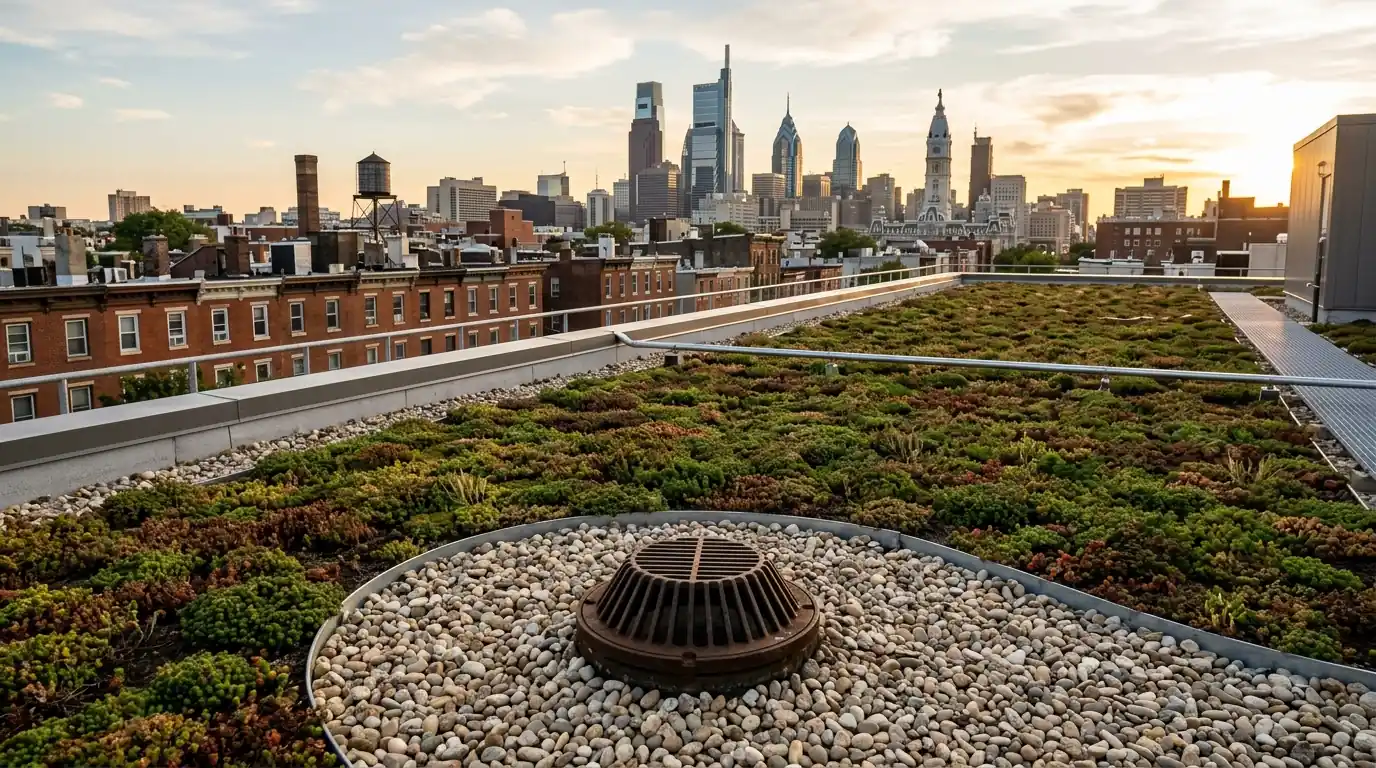
The tax credit pays for half, but a leak under a planted roof costs far more to find and fix than one on a bare membrane. Most green roofs go on as part of a roof replacement: a new membrane with a root barrier, tested for leaks before anything covers it, then protection, drainage, filter fabric, growing medium and plants. Edges, drains and rooftop equipment are kept in gravel borders so they can be inspected without disturbing the planting.
Why the City Encourages Green Roofs
About 60% of Philadelphia's sewer system is combined, carrying both sewage and stormwater, so heavy rain can overwhelm it. Green roofs hold back part of the rain that falls on them and release the rest slowly, which is why the Water Department tracks them as stormwater controls. For a building owner, the side benefits are a cooler roof, a membrane shaded from the sun and, often, a longer roof life.
Common Questions
The city credit is against the Business Income and Receipts Tax, so it is for businesses filing that tax.
Half of the construction cost, up to $100,000 per building.
Yes. The application requires an engineer's report on the roof's condition and structural capacity.
The approved plans must cover at least 60% of the rooftop.
If it is not maintained for five years, the credit has to be repaid.
Costs actually incurred to construct the green roof count; keep invoices for every part of the work.