Copper Roofing and Gutters in Philadelphia
Copper is what many of the city's older houses were built with: bay roofs, valleys, flashing and gutters that last for generations when they are soldered and detailed properly.
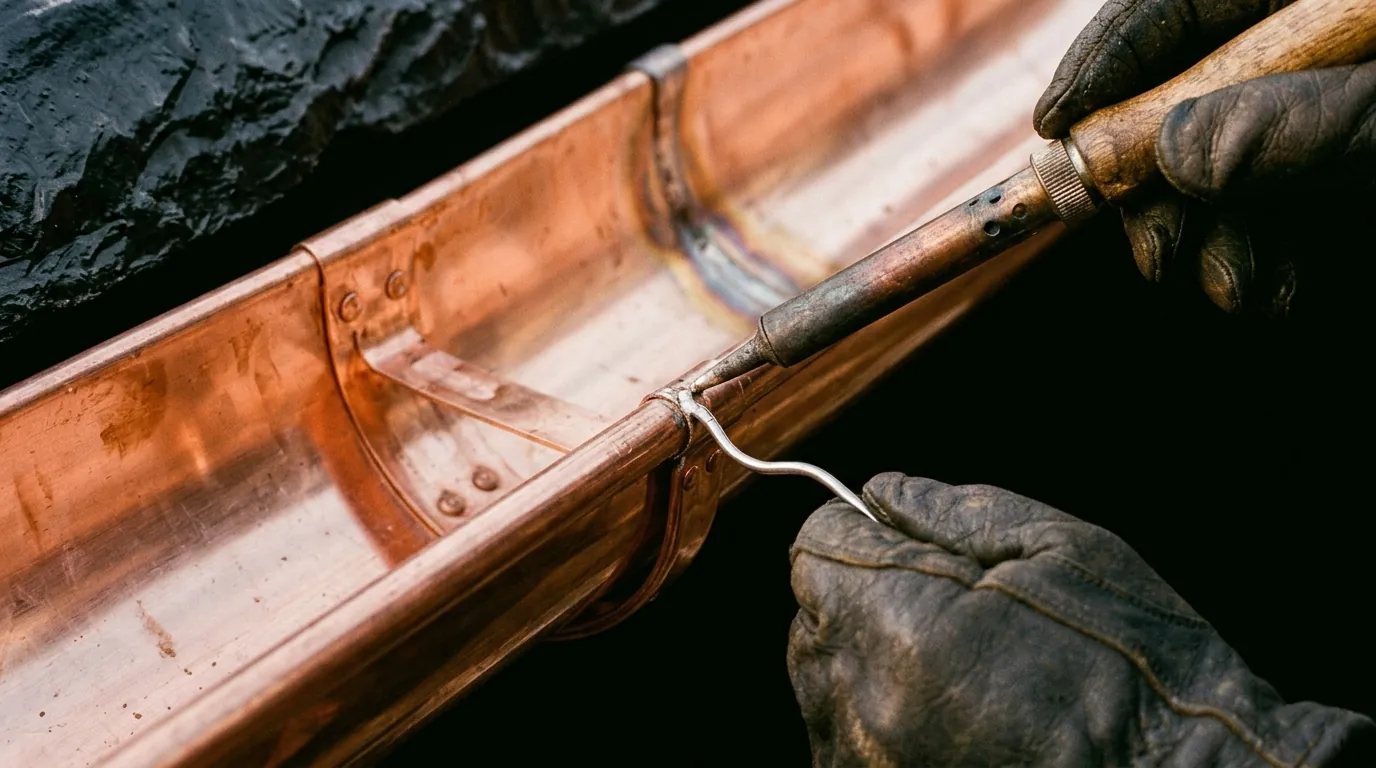
Copper roofing work covers small roofs over bays, porches and dormers, valleys and flashing on slate roofs, and half-round copper gutters and downspouts. It is formed and soldered on site, fastened with copper only, and left to weather from bright to brown to green. Repairs re-solder or replace failed sections; new work is built to last as long as the slate around it.
Where Copper Belongs on a House
On older Philadelphia houses copper shows up in specific places: standing or flat seam roofs over bay windows and porches, valleys between slate slopes, step and counterflashing at chimneys and walls, and half-round gutters hung below the eaves. It is chosen because it outlasts other sheet metals by decades and can be soldered into watertight joints.
Copper fails at its joints and fasteners, not usually in the sheet itself. Cracked solder, seams that were never soldered, steel nails that react with the copper and sections replaced with mismatched metal are what we see most. Repairs use copper and lead-free solder, and new work is formed to match the house rather than swapped for aluminum.
What Sets the Price of Copper Work
- Copper weight and amountCopper prices move with the metal market.
- Soldering and formingMost copper work is skilled hand labor.
- Slate around the workValleys need slate lifted and reset.
- Height and accessUpper bays and gutters need lifts or scaffolds.
- Repair or replaceRe-soldering costs less than new sections.
Copper is priced per job after measuring, since the metal price and the slate around the work change from house to house.
Copper, Aluminum or Coated Steel?
Copper is not the right choice for every house.
| Metal | When it fits | Tradeoff |
|---|---|---|
| Copper | Slate roofs, historic houses, long service life | Highest cost, weathers to green |
| Aluminum | Standard gutters on newer houses | Lower cost, shorter life, not soldered |
| Coated steel | Some standing seam roofs | Durable, but not for slate valleys |
Copper Bay and Porch Roofs
Bay windows, entry porches and oriels often carry small copper roofs in flat seam or standing seam. When they leak, the cause is usually a cracked solder joint, a seam opened by expansion or the flashing where the bay roof meets the wall. We re-solder or replace failed pans, rebuild the wall flashing and replace sections in matching copper so the roof keeps its look as it weathers. New copper looks bright at first and darkens within months, so a patched bay roof soon blends with the old metal around it, especially once the first winter has passed.
Copper Valleys and Flashing
On slate roofs the valleys and flashing are usually the first parts to wear out, long before the slate. We replace worn valleys with new copper, lifting and resetting the slate along each side, and rebuild chimney and wall flashing in copper step and counterflashing set into the mortar. Fasteners are copper or stainless, never steel, so nothing corrodes the new metal from behind. Because the valley is usually the first thing to fail on a sound slate roof, replacing it in copper can add decades to the roof without touching the rest of the slate.
Copper Half-Round Gutters
Half-round copper gutters on hanging brackets suit older houses better than standard K-style gutters. We replace failed sections, re-solder leaking end caps and outlets, and install new runs and round copper downspouts where old ones have split. Where a house has built-in box gutters behind the cornice instead, those are relined rather than replaced with hanging gutters. Copper gutters are hung on copper or brass brackets spaced for snow load, pitched to the outlets, and soldered at every joint. Downspouts are strapped to the masonry with copper straps so nothing stains the brick.
What Our Copper Work Includes
These details decide how long copper lasts.
- Copper of a stated weight
- Lead-free solder at every joint
- Copper or stainless fasteners only
- Expansion joints on long runs
- Cleats rather than face nails
- Counterflashing set into mortar
- Matching profile on repairs
- Downspouts sized to the gutter
- Clean edges ready to weather

Copper valley or gutter leaking?
Call and we re-solder or replace it in copper.
What We See on Philadelphia Roofs
Philadelphia's historic townhouses, including Federal and Georgian houses, often have tin-lined box gutters that need specialized care and period-correct repair, and the copper bays, valleys and half-round gutters on older houses deserve the same approach. That is why we form and solder metal on site to match the house rather than substituting aluminum, and why repairs use the same weight of copper and the same seam style as the original work, so the patch weathers into the old metal instead of standing out.
How a Copper Job Runs
- 1
Inspect
Seams, solder, fasteners and slate checked.
- 2
Measure and plan
Profiles and lengths taken from the house.
- 3
Form the copper
Pans, valleys and gutters shaped.
- 4
Install
Cleated and fastened in copper or stainless.
- 5
Solder
Joints soldered watertight with lead-free solder.
- 6
Reset and clean
Slate reset, site cleaned.
Copper Roofing and Gutter Questions
Over years it weathers brown, then to the familiar green patina.
Yes, by soldering in a new piece of copper.
No. The two metals react and corrode at the joint.
Like-for-like repairs often do not; visible changes on listed houses may.
Properly installed, many decades, often longer than the slate around it.
More Replacement & Installation Work in Philadelphia
From our guides: Repair or Replace Your Roof?
Keep Your Copper Working
Call and we solder, re-flash or replace it in copper.