PVC Roofing in Philadelphia
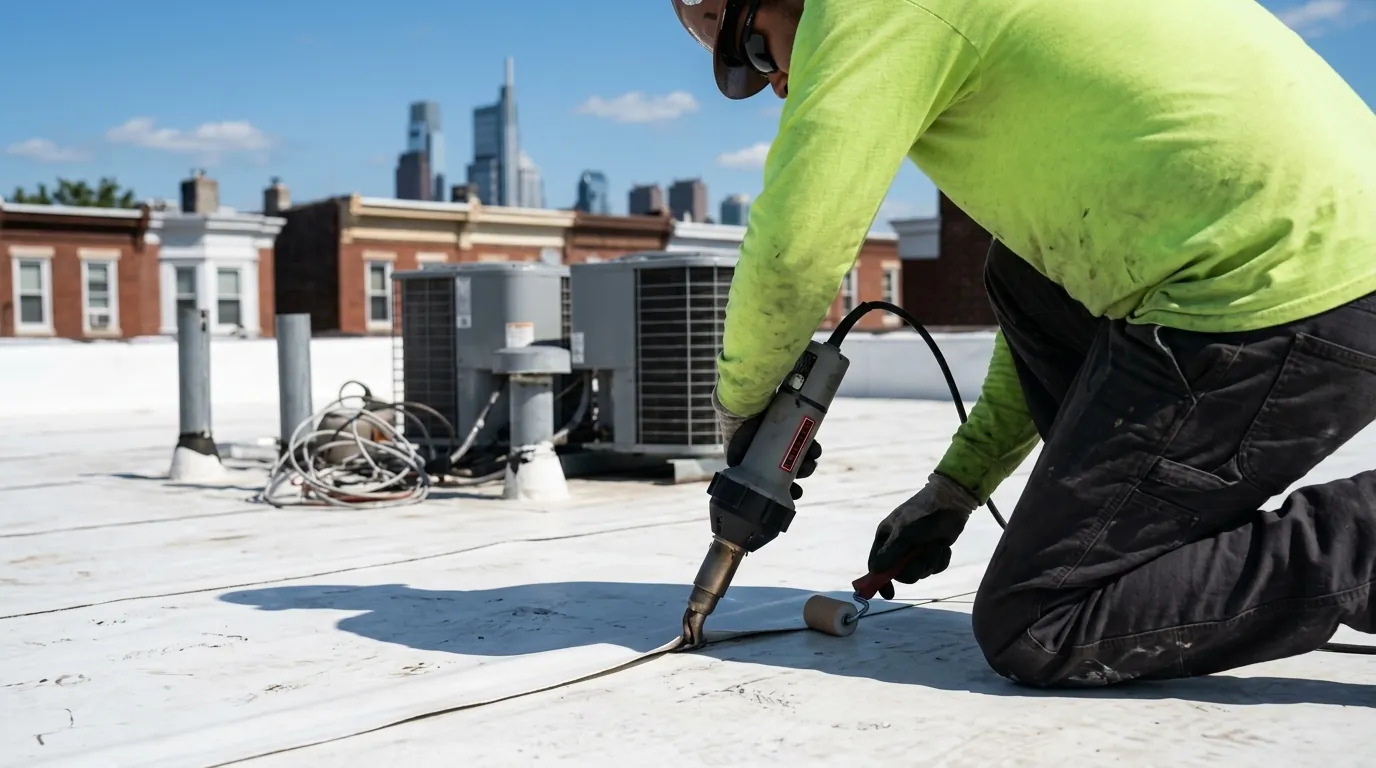
PVC is a single-ply membrane with heat-welded seams. It is a good fit for flat roofs that carry decks, equipment or kitchen exhaust, where other membranes struggle.
A PVC roof is a flexible single-ply membrane, usually white, fastened or adhered over insulation and joined with hot-air welded seams. It resists grease and many chemicals, which suits restaurant roofs, and its welded seams hold up under decks and rooftop equipment. It costs more than modified bitumen or EPDM but is a strong choice where those wear out early.
Where PVC Makes Sense
Most rowhome flat roofs in the city are modified bitumen, and that is often still the right choice. PVC earns its place on roofs that are harder on membranes: roofs under decks and pedestals, roofs with kitchen exhaust fans that drop grease, and commercial roofs crowded with equipment and foot traffic.
Like TPO, PVC is welded with hot air rather than glued, so a good seam is as strong as the sheet. It is reflective in white, which keeps the building below cooler, and the same membrane can be welded into flashing at parapets, curbs and drains. The installer's welding skill matters more than the brand, so seams are probed along their full length before we leave.
What Sets the Price of a PVC Roof
- Roof areaPriced per square across the roof.
- Tear-off or recoverLayers removed or a recover board added.
- InsulationRequired values and tapered areas.
- Penetrations and equipmentCurbs, fans and posts to flash.
- Decks and paversRemoval and reinstallation if present.
PVC roofs are priced after a survey, since the existing layers and the equipment on the roof change the scope.
PVC, TPO, EPDM or Modified Bitumen?
Each membrane suits different roofs.
| Membrane | Best for | Tradeoff |
|---|---|---|
| PVC | Restaurants, decks, equipment-heavy roofs | Highest cost of the four |
| TPO | Large commercial and residential flat roofs | Welded seams, less grease resistance |
| EPDM | Simple roofs, low cost | Taped seams, dark unless coated |
| Modified bitumen | Rowhome flat roofs | Walkable and familiar, more seams |
PVC on Rowhome Flat Roofs
On a rowhouse, PVC is worth considering when the roof will carry a deck or when the owner wants a white, welded membrane with long seams that do not rely on adhesive. We strip to the deck, add tapered insulation where water has been ponding, fasten the PVC and weld every seam, then flash the parapets and the joint with the neighbors' roofs, which are usually a different material. The joint with each neighbor is detailed with a compatible transition so neither roof is left with an open seam at the party wall.
PVC on Commercial Roofs
Restaurants, food plants and buildings with kitchen exhaust are where PVC is strongest, because grease and oils break down many other membranes. On commercial roofs we survey the existing roof, decide between tear-off and recover, install insulation to the required value and weld the PVC, with walkway pads to the equipment and grease guards at exhaust fans. Older PVC roofs can usually be repaired by welding in new membrane, which we check before recommending a replacement. Where the old membrane has gone brittle, a weld will not hold and replacement is the honest answer.
PVC Under Roof Decks and Equipment
Roofs under decks, pavers and rooftop equipment are hard to reach once they are covered, so the membrane needs to last. PVC with welded seams and reinforced flashings at every post and curb holds up well there. We install protection layers under pedestals and sleepers so the deck structure never rests directly on the membrane. Before the deck goes back, we water-test the finished membrane and photograph it, because once the deck is down it is hard to see. That record is useful if a leak is ever questioned later.
Roof under a deck or kitchen exhaust?
Call and we will tell you whether PVC fits.
What We See on Philadelphia Roofs
The Philadelphia Rowhouse Manual says a roof deck needs zoning and building permits and does nothing to waterproof the house, so the roof under it must be in very good condition first. That is where PVC with welded seams earns its cost. The same guide notes that some rowhouses have almost flat roofs and no attic at all, so a re-roof is the one chance to add rigid insulation above the deck before the new membrane goes on.
How Long a PVC Roof Takes
A rowhome PVC roof usually takes one to two days including tear-off. Commercial roofs are phased by area so the building stays watertight each night, and the schedule depends on size, insulation and how much equipment must be worked around.
How a PVC Roof Goes On
- 1
Survey
Layers, deck and wet insulation checked.
- 2
Tear off or prepare
Old roofing removed or a recover board laid.
- 3
Insulate
Insulation and tapered areas installed.
- 4
Lay and fasten
PVC fastened or adhered.
- 5
Weld the seams
Every seam hot-air welded and probed.
- 6
Flash and finish
Parapets, curbs and drains welded in.
PVC Roofing Questions
For grease, chemicals and decks, usually; for plain roofs, TPO often costs less.
Yes, especially under a roof deck.
Yes, with walkway pads on regular paths.
Yes, by welding a patch of the same membrane.
Yes, it reflects much of the summer sun.
More Replacement & Installation Work in Philadelphia
From our guides: TPO, EPDM or Modified Bitumen for a Rowhome Roof?
Ask If PVC Fits Your Roof
Call and we survey the roof and compare the options.