Chimney Removal in Philadelphia
An unused chimney is a tower of old mortar on your roof that still needs flashing, pointing and a crown. When it no longer serves a furnace, water heater or fireplace, taking it down can end the maintenance for good.
Chimney removal means taking an unused chimney down by hand, usually to below the roofline, capping or framing the opening, and patching the roof deck and covering so the spot disappears. First we confirm nothing still vents through it, because furnaces, boilers and water heaters often do.
When Taking a Chimney Down Makes Sense
Many rowhouse chimneys no longer serve anything: the fireplace was closed decades ago and the heater vents elsewhere. Yet the chimney still needs repointing, a crown and flashing, and an old one is a common leak source. Removing it to below the roof takes away the leak point and the upkeep in one job.
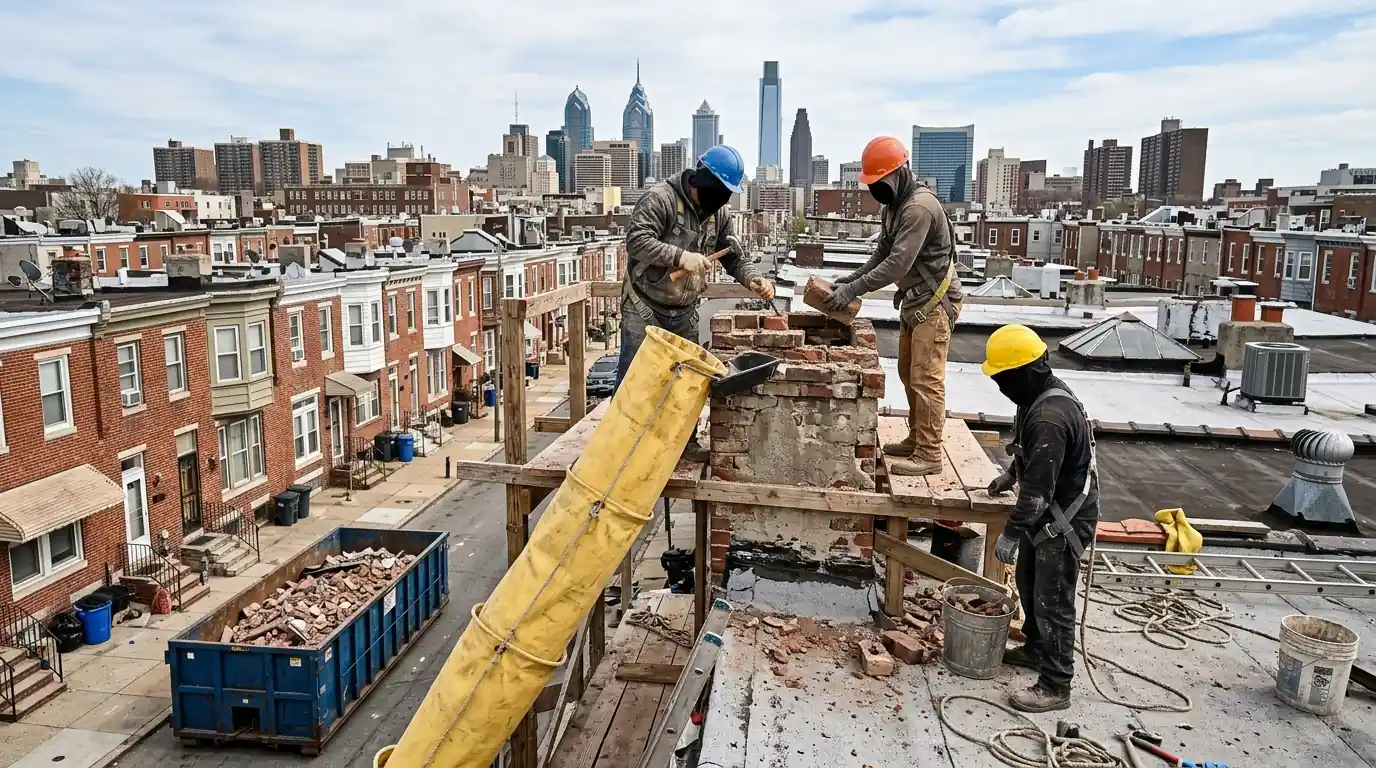
Before any brick comes down, we confirm with the owner and, where needed, a heating contractor that no appliance vents through it. Then the chimney is taken down brick by brick, never pushed over, and the debris is lowered or chuted to a container. The opening is framed, decked and roofed to match, and the flue below is capped if the chimney stays in the attic or wall.
What Sets the Price of Chimney Removal
- Chimney size and heightMore brick takes longer to remove.
- How far downBelow the roof, to the attic or further.
- Debris removalChute, buckets and container.
- Roof patchMembrane, shingle or slate to match.
- Shared wallsParty-wall chimneys need extra care.
Chimney removal is priced after we see the chimney, the roof and what still vents through it.
Should You Take a Chimney Down Yourself?
Removal looks simple from the street; on a roof it is heavy, dusty and dangerous.
What a homeowner can safely do
- Find out what vents through the chimney now
- Check whether the fireplace below is already closed
- Photograph the chimney and the roof around it
Where it needs a roofer
- Taking the brick down safely by hand
- Capping a flue that stays in the wall
- Framing and roofing the opening to match
Taking a Chimney Down Below the Roofline
Removing the chimney to just below the roof deck is the most common job. We protect the roof around the chimney, take the brick down by hand course by course and lower it in buckets or through a chute. Once below the deck line, the top of the remaining stack is capped and sealed. If the chimney sits on a party wall, we keep the work on your side and protect the neighbor's roof and flashing. Debris is kept off the roof surface and out of the gutters.
Roof and Deck Patch After Removal
With the chimney gone, the hole in the roof is framed between the joists or rafters and decked over. On a flat roof the membrane is patched or, if the roof is near the end of its life, the chimney removal is folded into a full replacement. On shingle and slate roofs the covering is woven in so the patch matches. The old flashing goes with the chimney, which removes a common leak point. Inside, the ceiling below the old chimney is checked for past water damage so it can be repaired once the roof is closed.
Partial Removal and Capping
Sometimes a chimney can be lowered rather than removed, for example when it still carries a flue or when a full removal would disturb a shared wall. We take it down to a sound course, rebuild the top few courses, install a new crown and cap, and re-flash it at the roof. That keeps a working flue while removing the loose, weathered top that causes most chimney leaks. A partial removal costs less than a full one and still ends the worst of the maintenance, because the top courses are where mortar fails first and where most leaks start.
What a Chimney Removal Includes
Every removal we quote lists these steps.
- Confirm no appliance vents through it
- Permit check for your address
- Roof and neighbor protection
- Hand removal, never pushed over
- Debris lowered or chuted
- Cap on the remaining stack
- Opening framed and decked
- Roof patched to match
- Site and gutters cleaned
Chimney leaking and unused?
Call and we confirm it can come down.
What We See on Philadelphia Roofs
The Philadelphia Rowhouse Manual's maintenance list calls for a chimney sweep to clean and inspect chimneys once a year and for a professional to check them for loose bricks, and repointing is the most frequently needed chimney repair in the city because aging lime-based mortar breaks down faster than the brick. On a chimney that no longer vents anything, that upkeep never ends, which is why removal is often the better spend.
How a Chimney Removal Runs
- 1
Confirm it is unused
Appliances and flues checked.
- 2
Protect
Roof, neighbors and gutters protected.
- 3
Take it down
Brick removed by hand to the agreed level.
- 4
Cap
Remaining stack capped and sealed.
- 5
Frame and deck
Opening framed and decked over.
- 6
Roof and clean
Roofing patched to match, debris hauled.
Chimney Removal Questions
Often, if the work stays on your side and the neighbor's flue is unaffected.
It depends on the scope; we check for your address.
If the chimney was the leak, yes, because its flashing goes too.
Yes, with a new crown and cap if a flue is still used.
It is lowered and hauled away with the debris.
More Masonry & Rowhome Details Work in Philadelphia
From our guides: Roofing Permits Outside Philadelphia
Take the Leak Point Off Your Roof
Call and we check whether the chimney can come down.