By Fern Goddard, Roofing Guides EditorUpdated September 2026
Attached rowhomes share parapet walls, roof lines and sometimes drains, so water can enter at a neighbor's coping, seam or scupper and travel under the membrane into your house. The fix starts with tracing the entry point, photographing it, and repairing the joint between the two roofs properly, with both owners informed when the source is next door.
How Rowhome Roofs Connect
Philadelphia rowhomes share their side walls, called party walls, and on many blocks those walls rise above the roof as parapets with coping on top. Elsewhere the roofs simply run into each other with a seam over the wall. Either way, each house's roof has to be sealed to the neighbor's, and the two are often different materials installed decades apart.
Why Leaks Travel
Water that gets in at a neighbor's coping, an open seam at the property line or a blocked shared drain does not stay where it entered. It can run along the top of the party wall, under the membrane or along joists before it shows on a ceiling. That is why a stain in your house is not proof that your roof is the one that failed.
The Older Walls Under the Roof
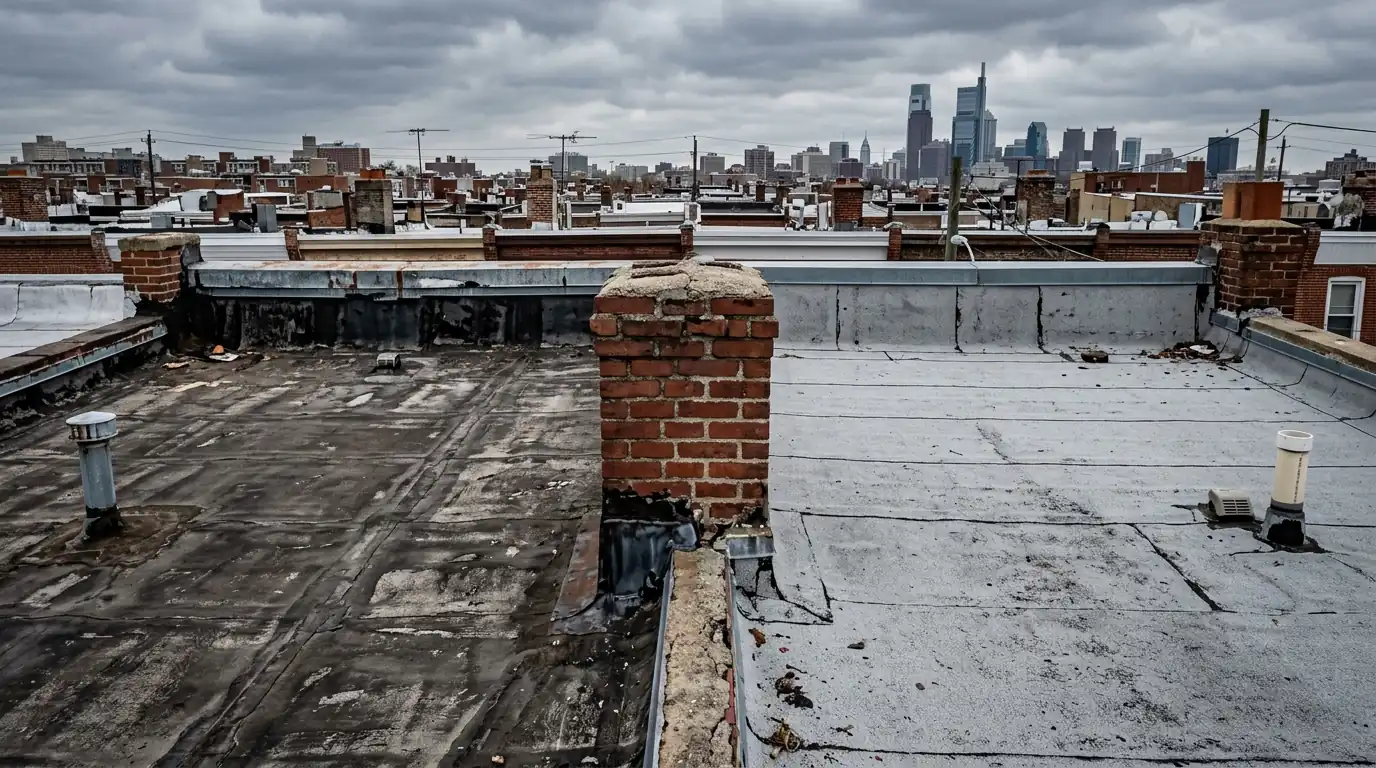
On houses built before about 1920, the party walls were often laid with lime mortar, and the joists were set parallel to the front of the house, so the front and rear brick walls were tied only to the party walls. Mortar that has washed out of the top of a parapet lets water into the wall itself, where it can run down inside and appear well below the roof.
Tracing the Source
We start inside, at the stain, and work up: the ceiling, the attic or roof cavity where there is one, then both roofs at the party wall. Coping joints, the seam between the two roofs, flashing up the parapet, and any shared scupper or drain are checked. Where it helps, sections are water-tested one at a time so the entry point is confirmed rather than guessed.
Leak coming from next door?
Call and we trace it and show you where it starts.
When the Problem Is Next Door
If the water is entering on the neighbor's roof, we photograph it, explain it, and tell you plainly. Often the most practical fix is a single repair to the joint that both owners share, done with the neighbor's agreement. Where the neighbor's roof is failing more widely, the joint can still be sealed on your side so your house stays dry while they arrange their own repair.
Fixing the Joint Properly
A lasting repair ties the two roofs together with compatible materials: new base flashing up the parapet, counterflashing or a new coping cap on top, and a transition between different membranes at the property line. Open coping joints are repointed or capped. Shared drains and scuppers are cleared and re-flashed so neither roof floods the other.
Where the Water Must Go
The city's own rowhouse guidance says roof water has to end up on your own property, not on a neighbor's roof or lot, the sidewalk or the street. When we fix a shared joint, we also check that each roof drains to its own outlet. A downspout or scupper that dumps onto the next roof is a common hidden cause of leaks between houses.
Common Questions
Usually the owner whose roof is failing; a photographed tracing helps the conversation.
Yes, and we seal the joint at the property line so your roof stays dry.
Water runs along the wall top, membrane or joists before it shows.
Yes. Coping joints and mortar at the top fail first and should be checked regularly.
Yes, with a compatible transition detail at the property line.
It is shared; keeping it clear and properly flashed protects both houses.