
By Fern Goddard, Roofing Guides EditorUpdated September 2026
Most porch roof leaks start in three places: the joint where the porch roof meets the house wall, the front edge and gutter, and a worn covering on a nearly flat surface. Stains on the porch ceiling, sagging boards and soft fascia are the usual first signs. A lasting repair fixes the flashing and replaces wet wood instead of coating over it.
Why Porch Roofs Wear Out First
A porch roof sits just under the second-floor windows and often takes the runoff from the main roof or a downspout spilling onto it. It is close to flat, so water lingers, and it gets full sun. The covering is often rolled roofing or an older membrane that was never meant to last as long as the main roof. On streetcar-era rows with continuous porches, the porch roof may also be shared with the houses on either side.
Where the Water Gets In
The most common entry point is the joint with the house wall, where water running down the brick has to be turned onto the roof. Old porches often rely on tar or caulk there, which cracks. Next is the front edge, where water spills into a small gutter or straight off, and where rot in the fascia lets it run back underneath. Last is the covering itself: splits, open seams and blisters.
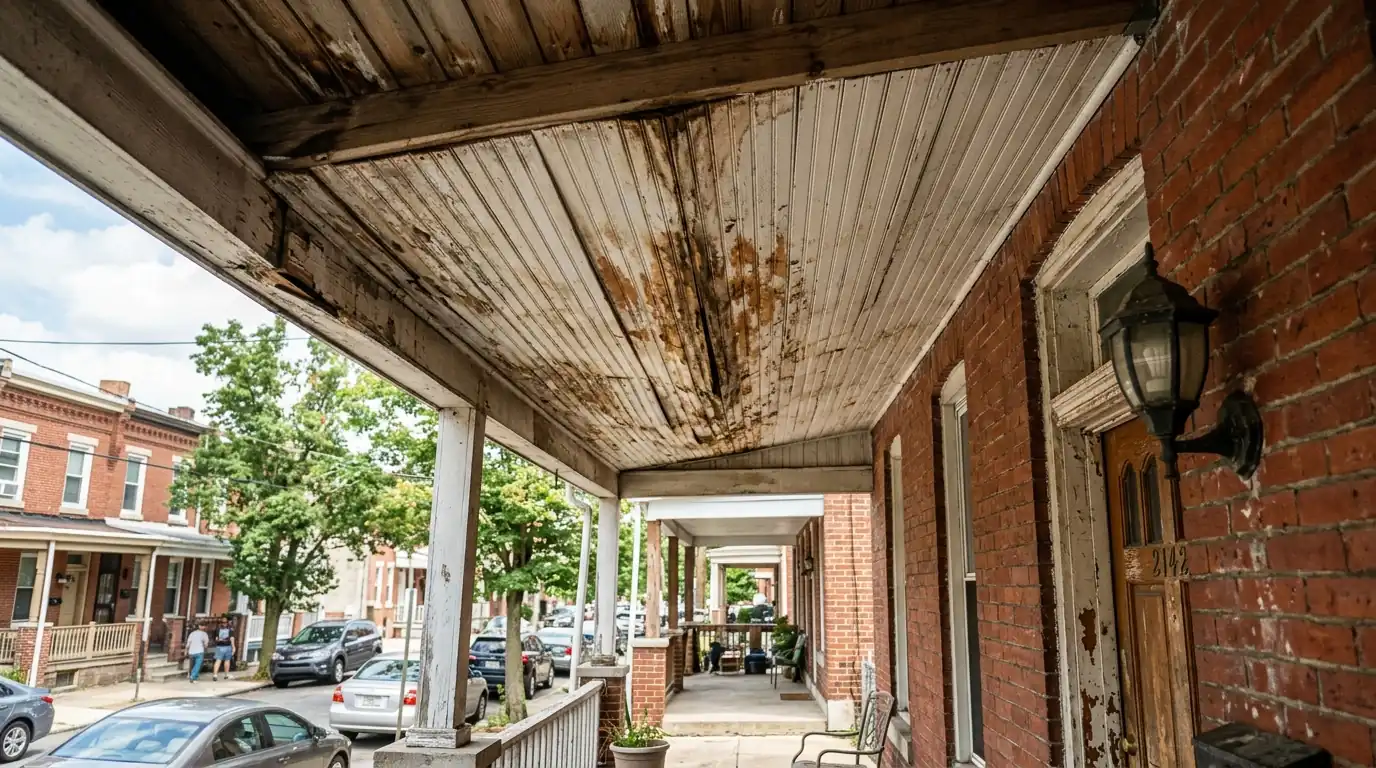
Reading the Porch Ceiling
The porch ceiling tells the story. A stain near the house wall points to the wall flashing; a stain along the front points to the edge or gutter; a stain in the middle usually means the covering. Sagging beadboard means the boards have been wet for a long time, and soft or split fascia along the front means the rot has reached the structure that holds the gutter.
What You Can Check Yourself
From the ground or a window, look for standing water on the porch roof after rain, tar patches along the wall, a downspout emptying onto the porch roof and a gutter that overflows. Inside, note where ceiling stains appear and whether they grow after storms. Photographing them over a few weeks helps narrow the source before anyone climbs up.

Porch ceiling stained again?
Call and we find the leak and fix the wood.
Patch, Recover or Rebuild
A small split or a failed joint on a sound covering can be patched. A covering at the end of its life is replaced, with soft decking replaced and the slope nudged toward the front so water leaves. Where the wall joint is the problem, a reglet is cut into the mortar and counterflashing installed over new base flashing. Rotted ceiling boards and fascia are replaced to match, then painted or capped.
Shared Porch Roofs
On rows where the porch roof runs continuously across several houses, each owner's section has to tie into the next. A repair that stops at the property line without sealing the joint just moves the leak. We seal the joints with the neighbors' sections, photograph them, and tell the owner when the problem is clearly coming from next door.
When the Problem Is Structural
If the beam carrying the front of the porch roof is soft, or the posts or columns have rotted at the base, the porch roof may sag regardless of the covering. That is structural carpentry rather than roofing, and it should be fixed before or alongside a new roof. A porch roof that feels springy underfoot or has a visible dip along the front edge needs a closer look at the framing.
Common Questions
Usually the wall flashing or the front edge overflows when the volume of water is high.
Coatings do not fix failed flashing or wet decking, and they can trap water under them.
Most take a few hours to a day; wood repairs can add half a day.
A like-for-like recovering often qualifies for the simpler re-roofing permit in the city; we confirm.
If both are near the end of their life, doing them together saves setup and ties the joints in properly.
Only after the rot is cut out; capping over rot hides it and lets it spread.